.webp)



There are so many strategies and tactics that today’s marketers can employ to help their businesses grow. From traditional efforts like direct mail to online efforts, including SEO, ads, and content development, there is a lot to do and a lot to analyze.
But this begs the question. How do marketers and business owners really know how their efforts are paying off? Which tactics are actually helping to drive purchase decisions? And is it just one tactic, or is it a combination of many?
This is why understanding what multi-touch attribution is and how it works is such a vital component of your overall marketing strategy. And in this article, we’ll explain just what mult-touch attribution is, how privacy and artificial intelligence (AI) search have all but broken last-click measurement, and how to build a highly effective mult-touch attribution reporting system. Why? Because at LAMA Marketing, we’re here to help you make the most of your marketing efforts.
What is Multi-Touch Attribution?
Before we get too far down the path, let’s take a moment to make sure we’re aligned on just what multi-touch attribution is in the first place. Multi-touch attribution (MTA) assigns conversion credit across all the interactions that influence a buying decision. Instead of giving 100% of the credit to a single click, MTA looks at the full path a buyer takes, which may include paid ads, organic search, email, webinars, events, sales conversations, and repeat site visits.
This approach reflects how people actually make decisions. Most conversions happen after multiple interactions, especially in longer B2B cycles or higher-consideration purchases.
That’s where MTA differs from simpler models:
- First-touch attribution credits the first interaction. It helps identify how prospects are introduced to a brand, but ignores everything that follows.
- Last-touch attribution credits the final interaction before conversion. It’s easy to report on, but it often overvalues late-stage actions.
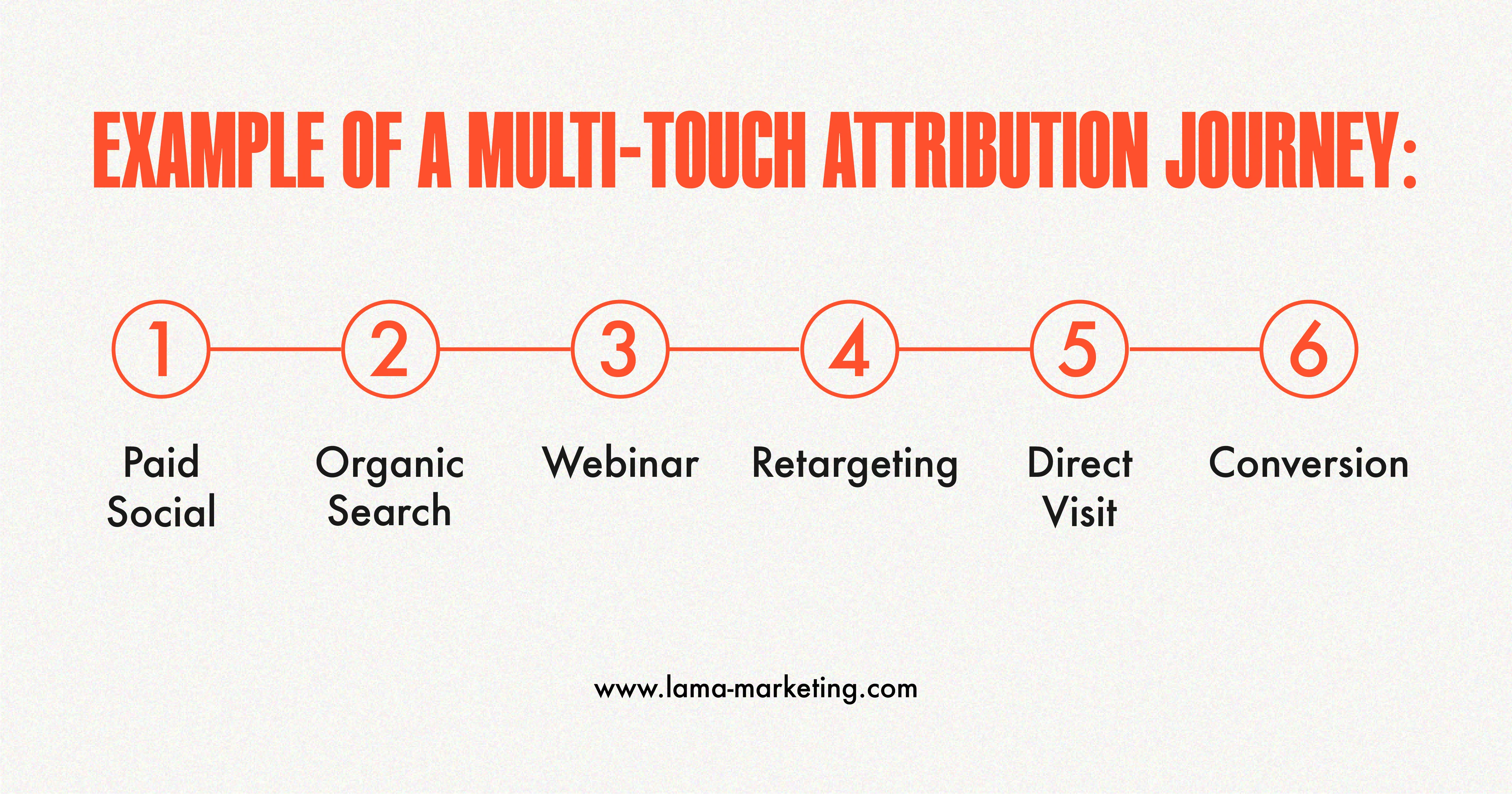
Consider this journey: paid social → organic search → webinar → retargeting → direct visit → conversion.
In a last-touch model, “direct” would get all the credit. MTA spreads credit across the full journey, showing how each interaction contributed. That fuller view helps teams understand how channels work together instead of judging them in isolation.
Why Multi-Touch Attribution is More Important Now in 2026
Multi-touch attribution isn’t gaining attention by accident. This year, the MTA market is projected to reach roughly $2.8 billion, with steady growth expected over the next several years as marketing measurement gets more complex. Privacy-first data rules, blended online and offline journeys, and expanding channel mixes have made simple reporting harder to trust.
Even so, we estimate that about 40–45% of marketers still rely on last-touch attribution for online channels. That’s a risky move. At the same time, roughly 75% of businesses now use some form of multi-touch attribution to measure performance, and we agree that this direction makes sense. The reasons why matter more now than ever.
So with that, let’s take a look at just why we think multi-touch attribution needs to be the path forward in 2026.
Privacy and Consent-Driven Data Loss is Now the Default
Attribution has shifted from a clean tracking exercise to one shaped by consent choices and data gaps. Attribution in GA4 is defined as assigning credit across multiple touchpoints and allows teams to compare models, including data-driven attribution. That flexibility exists because full user-level paths are no longer guaranteed. Google Ads has also adjusted how it approaches tracking as third-party cookies fade and privacy timelines evolve.
To operate in this environment, many teams rely on server-side tracking to pass first-party events in a more controlled, privacy-aligned way when browser signals fall short. Platforms also increasingly use conversion modeling to estimate outcomes when direct measurement isn’t available, helping preserve trend visibility without claiming perfect accuracy. In 2026, attribution isn’t about flawless tracking—it’s about working with partial data in a structured, repeatable way.
Cross-Device and Browser Fragmentation Breaks “One User = One Journey”
The idea that a single user follows one clean, trackable path no longer reflects how people behave. Mobile now drives most high-intent activity in many sectors, accounting for roughly 78% of traffic to retail sites. At the same time, nearly half of online purchases involve switching between devices before conversion.
Add in Safari’s tracking limits, app-level consent changes, and browser restrictions, and those journeys quickly splinter. What once looked like one person now appears as several disconnected sessions.
This isn’t a failure of measurement. It’s the operating environment. Multi-touch attribution accounts for this fragmentation by focusing on channel influence across patterns, not pretending every step belongs to one identifiable user.
AI Search Changes the Role of Channels, Especially Organic
AI-driven search experiences are reshaping how people interact with results. Research from Pew Research suggests that users click external links far less often when an AI summary appears: about 8% compared to 15% without one. Industry reporting echoes this trend, with AI Overviews lowering click-through rates.
Organic search hasn’t lost value, but its role has shifted. It now supports awareness and consideration more often than it closes the loop. Multi-touch attribution helps teams see organic as an assist channel rather than judging it solely on last-click performance.
Single-Touch Attribution Actively Misallocates Budget
Relying on a single touchpoint to explain revenue leads to distorted decisions. Last-touch models tend to over-credit brand search, retargeting, and direct traffic because those actions happen late. At the same time, they under-credit awareness efforts, educational content, and mid-funnel campaigns that shape intent earlier.
The result is a budget pulled from the channels that create demand and pushed toward those that simply capture it. Multi-touch attribution reveals how channels work together, helping teams avoid cutting programs that quietly support downstream results.
Tools to Know and Use for Multi-Touch Attribution
It’s pretty clear that multi-touch attribution is the way to go, especially if you want to build brand awareness and ultimately drive conversions. But trying to manage it with old-school spreadsheets and a calculator isn’t going to help you easily obtain the information you need to inform future marketing decisions.
Thankfully, there are a variety of tools available to marketers and business owners to help them tackle the beast more easily.
The Multi-Touch Attribution Tool Landscape (and How to Choose)
Not every attribution platform fits every business. The right choice depends on how you sell, where demand comes from, and what decisions you need the data to support. Before evaluating vendors, it helps to define a simple framework.
- Business type: B2B SaaS, ecommerce, and lead generation teams measure success differently and need different levels of funnel detail.
- Primary channels: Paid social, Google Ads, lifecycle email, affiliates, and events all create different signals that tools must ingest and align.
- Systems of record: Your CRM (Salesforce or HubSpot), ecommerce platform, or data warehouse will anchor attribution logic.
- Required outputs: Pipeline and revenue attribution, CAC and LTV by channel, creative-level insights, and cohort payback timelines.
Clear answers here narrow the field fast and prevent overbuying technology that doesn’t match how your business actually operates.
Leading Platforms (with Benefits and Pricing Notes)
Once you’ve decided that multi-touch attribution belongs in your measurement stack, the next question is practical: which platform should you use? Sorting through vendors, features, and pricing takes time that many teams don’t have. That’s where a little guidance helps.
Below, we’ve done some of the early legwork by highlighting several leading platforms and what they’re commonly used for. These examples can help narrow your shortlist and frame smarter conversations with vendors.
One note before we start: pricing changes often. Any public figures should be treated as directional, and it’s always smart to confirm current terms directly with each provider.
Google Analytics 4 + Google Ads Attribution (baseline, not full MTA)
For many teams, GA4 paired with Google Ads serves as an entry point into attribution. It works best for businesses operating primarily inside Google’s ecosystem and looking for directional insight rather than full-funnel clarity.
Benefits:
- Multiple attribution models available within GA4 reporting
- Native integration with Google Ads and Google signals
- No cost to get started with the standard GA4 property
Limitations:
- Identity loss across devices and browsers
- Frequent “(not set)” or unassigned traffic in reports
- Limited visibility into non-Google channels and offline activity
On pricing, Google Analytics 4 is free for businesses of all sizes. For large enterprises, Google Analytics 360 starts around $150,000 per year and offers higher data thresholds and expanded reporting suited for complex analytics environments.
HockeyStack (B2B revenue attribution and journey analytics)
HockeyStack is built for B2B teams that need a clearer link between marketing activity, pipeline movement, and closed revenue. It’s commonly used by SaaS and revenue teams that want visibility into how channels and touchpoints influence deals over time.
Benefits:
- Multi-touch journey reporting across long B2B sales cycles
- Strong focus on revenue, pipeline, and account-level insights
- Integrations designed to connect marketing data with sales systems
HockeyStack does not publish fixed pricing. To get exact numbers, teams typically complete a short form with details like company size and contact information and participate in an introductory call. Based on publicly referenced listings and user discussions, pricing often starts in the low thousands per month, with examples citing plans around $2,200 per month, depending on usage and configuration.
Dreamdata (B2B attribution + GTM analytics)
Dreamdata is designed for B2B SaaS teams that want attribution aligned with RevOps and go-to-market reporting. It connects marketing, sales, and revenue data to show how activity influences the pipeline over time.
Dreamdata is best suited for B2B SaaS teams that align marketing and revenue around shared performance goals.
Benefits:
- Multi-touch attribution built around account and pipeline views
- Clear linkage between campaigns, opportunities, and revenue
- GTM-focused reporting that supports longer sales cycles
Dreamdata offers a free starter plan for foundational B2B analytics. Attribution features require an advanced plan, which involves a demo. Third-party software directories commonly list starting pricing around $750 per month, typically covering two years of user activity and up to 25 seats, though terms may vary.
Ruler Analytics (closed-loop attribution for lead generation)
Ruler Analytics is commonly used by lead generation businesses that want clearer links between marketing activity and CRM outcomes. It focuses on tying sessions, leads, and revenue back to the channels that influenced them, including offline conversions.
Benefits:
- Closed-loop attribution connecting marketing data to CRM records
- Strong fit for businesses tracking phone calls, form fills, and sales outcomes
- Emphasis on linking sessions leads to downstream revenue
Ruler Analytics uses traffic-based pricing and asks teams to contact sales for a formal quote. Public pricing tiers shown on the vendor site start around £179 per month for up to 5,000 monthly visits, with higher tiers scaling based on volume and features.
Northbeam (e-commerce-focused multi-touch attribution)
Northbeam is built for e-commerce brands that need attribution tied directly to transactions rather than leads or pipeline. It emphasizes first-party data and cross-channel measurement to help teams understand how marketing activity contributes to revenue.
Benefits:
- Attribution aligned to e-commerce transactions and purchase behavior
- Strong focus on first-party data in privacy-limited environments
- Clear cross-channel narratives for paid and organic efforts
Northbeam uses tiered pricing based on spend, with plans typically labeled starter, professional, and enterprise. Public pricing indicates the starter plan begins around $999 per month. To determine fit and access detailed pricing, teams need to book a demo with the vendor.
How to Create Reporting Around Multi-Touch Attribution
Multi-touch attribution reporting works best when it’s built around clear choices and consistent rules. Before pulling reports, take time to define what you want the data to guide. Then structure reporting so results are easy to compare and act on.
- Define the decision you’re trying to make: Budget allocation by channel, creative optimization, funnel investment, or go-to-market alignment.
- Lock your conversion taxonomy: For lead gen, clarify leads, MQLs, SQLs, opportunities, and revenue. For e-commerce, define orders, first purchases, and renewals.
- Choose a primary attribution model with comparison views: Use a data-driven or algorithmic model as the default, with position-based or time-decay views as checks.
- Establish attribution windows: Set different lookback periods for prospecting and retargeting, aligned with your actual sales cycle length.
Common MTA Pitfalls and How to Avoid Them
If you want clarity into what’s working and what’s not, then multi-touch attribution is the ticket. But please keep in mind that it can only give you that clarity when it’s used with the right expectations. Most issues don’t come from the tools themselves. Rather, they come from how teams interpret and compare the data.
- Treating MTA as a single source of truth: Attribution is a model, not reality. Use it to guide decisions, not to declare absolute answers.
- Over-optimizing to short attribution windows: Narrow windows tend to favor late-stage channels and quietly pull support from awareness and education efforts.
- Comparing platforms without normalization: Different tools use different windows, models, and conversion definitions. Align these before drawing conclusions.
- Confusing incrementality vs attribution: Attribution shows where credit lands across touchpoints, while incrementality testing reveals whether a channel actually created lift. One does not replace the other.
- Ignoring AI search’s impact on assist behavior: As AI summaries reduce clicks, organic search often shifts earlier in the journey, contributing influence without closing conversions directly.

Making Marketing Attribution Models Work in 2026 and Beyond
There’s no denying that marketing measurement looks very different than it did even a few years ago. Privacy changes, cookieless measurement, AI search behavior, and fragmented journeys have reshaped how value shows up across channels. In this environment, cross-channel attribution matters more than chasing a single click or platform report. The teams seeing the clearest results are those focused on making the most of marketing attribution models as decision tools, not scorecards.
If you’re unsure how to connect data, choose the right models, or turn attribution insights into action, LAMA Marketing can help. We work with teams to design practical measurement frameworks that fit how your business actually grows. Reach out to start a conversation about building attribution that supports smarter decisions.